Production transfer to Southeast Asia, without losing grip on quality
The shift of manufacturing towards Southeast Asia is no longer a trend on the horizon, it is visible in the trade statistics. This raises a practical question for manufacturing companies: how can production volumes be moved to Southeast Asia while maintaining control over quality, cost, delivery and manufacturability? In this article, Bob van Hedel shares how a structured approach to production transfer made the difference.
Why production is moving to Southeast Asia
The shift of manufacturing towards Southeast Asia is no longer a trend on the horizon; it is visible in the trade statistics. Vietnam’s exports grew from US$265 billion in 2019 to US$475 billion in 2025, an average growth of more than 10 per cent per year. Malaysia followed a similar curve, from US$238 billion to US$375 billion in the same period. The semiconductor industry illustrates the shift even more sharply. In 2025, China’s imports of chipmaking equipment routed via Malaysia doubled to US$3.4 billion, while imports via Singapore rose 17 per cent and direct imports from the United States fell by a third.
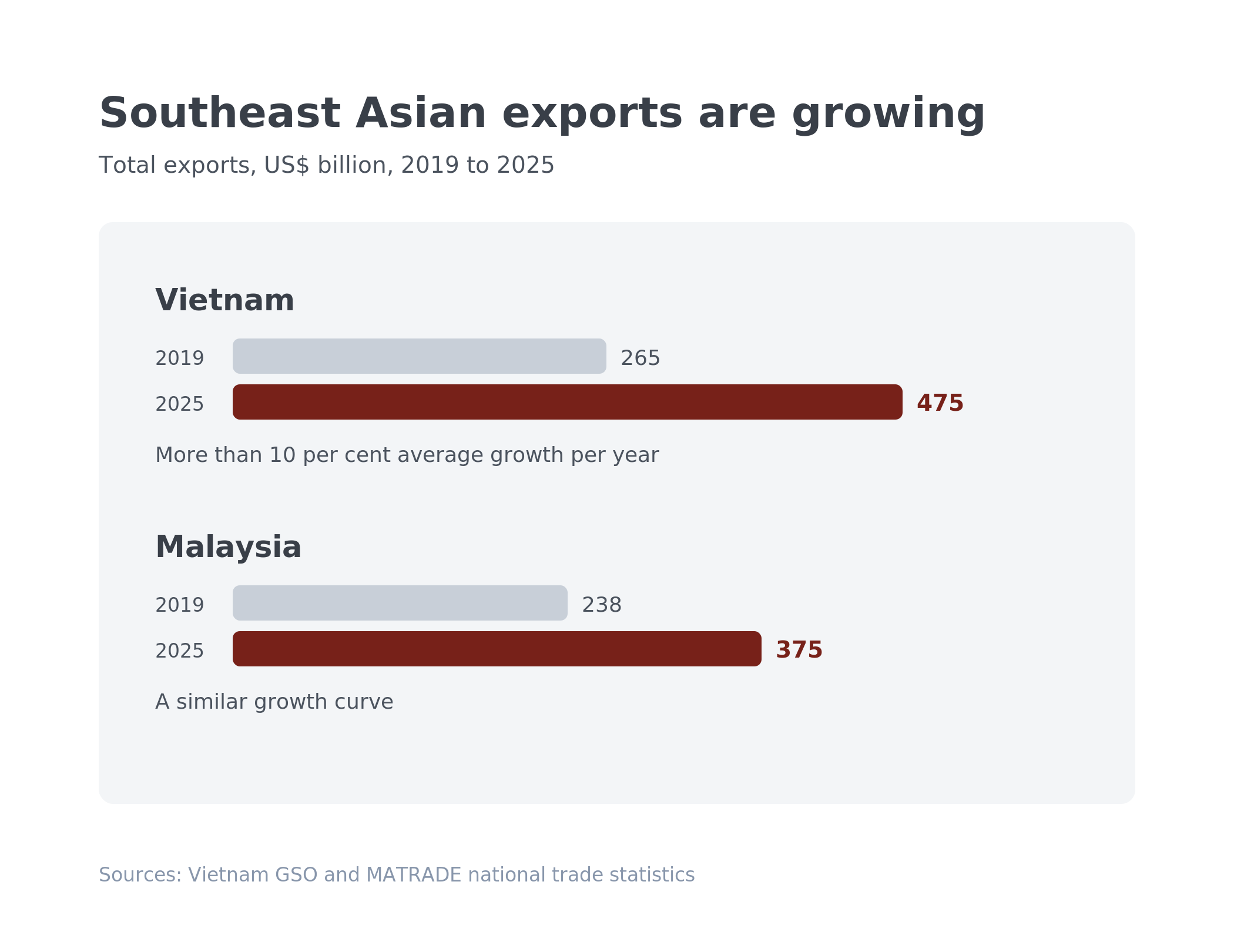
Rising costs, geopolitical pressure, and a desire to spread supply chain risk are driving OEMs and their suppliers towards a ‘China plus one’ strategy, with Malaysia and Vietnam being popular destinations. As the above numbers show, this production relocation is well underway. This creates opportunities in terms of capacity, cost efficiency and proximity to growing markets. However, it also poses a real risk. If a transfer is managed as a side project, quality and delivery performance can quickly decline, and the savings can evaporate during the ramp-up.
Bob van Hedel at the client
In February 2024, Bob began working on the Malaysia Transfer project for one of our clients, as Project Manager. The goal was clear. By moving production to sister companies in a more cost-efficient country, the client would be able to free up capacity in its internal operations and meet the price roadmap with the customer. This required a smooth transition of production volumes and an approach in which quality, cost, delivery and manufacturability were key considerations.
A structured production transfer with deliverables and gate checks
We used a transfer programme specifically set up within Nobleo to carry out such projects successfully.
'We worked according to a stage-gated process. This meant that the project was divided into clear stages, with each stage having a list of deliverables focused on quality, delivery, cost and manufacturability, in short QLTC.'
Bob van Hedel – Project Manager – Bob van Hedel – Project Manager
The use of gate checklists meant that the transfer remained manageable and predictable. Initially, the project started without clear agreements with the customer, which created uncertainty and unclarity within the project teams. However, we soon implemented a structured approach based on concrete agreements, supported by gate checks and a clearly defined process. As a result, the scope, expectations and responsibilities of all parties involved were clearly defined.
In addition, we introduced a systematic way of involving different management levels and project leaders in the process. “This approach has not only made the steps to be taken clearer, but has also ensured that everyone is now working from the same starting point,” says Bob. This improved cooperation has led to the project being implemented more efficiently and ensures that everyone is on the same page.
From consulting to implementing quality and manufacturability
One of the main challenges when moving production to ‘offshore’ locations is ensuring quality. To ensure quality, Bob not only advised on quality assurance, but also implemented measures to ensure production consistency. This included setting up processes and quality controls specifically for volume production in a new environment.
The second focus was on manufacturability. By collaborating closely with the engineering and production departments, Bob ensured that the designs were technically achievable and could be produced efficiently. Thanks to close cooperation with the customer, the production process for the first end products was released by the end customer. Since 2025, the end customer has been ordering directly from Malaysia.
What makes a production transfer succeed
Our way of working proves its value in complex projects such as the Malaysia Transfer. We combine operational progress with process optimisation, both of which are essential to achieve a successful transfer. Our unique approach combines a hands-on mentality with process expertise. We help you to define clear project goals, achieve them and align them with the relevant stakeholders.
Bob sums it up well:
"With our combination of operational and process expertise, we offer more than just advice, we deliver concrete solutions that have an immediate impact. This makes us more than just a partner, we become an extension of your own team on the factory floor, where the work happens."
Bob van Hedel – Project Manager – Bob van Hedel – Project Manager
Considering a production transfer to Southeast Asia, or already in the middle of one? We would be glad to explore what a structured transfer approach could look like for your organisation. Feel free to get in touch.
Achieving New Level Manufacturing Together
Considering a production transfer to Southeast Asia, or already in the middle of one? We would be glad to explore what a structured transfer approach could look like for your organisation.

Thinking about a production transfer to Southeast Asia? Feel free to contact us.
No commitment, just a conversation. We will get back to you within two business days.