
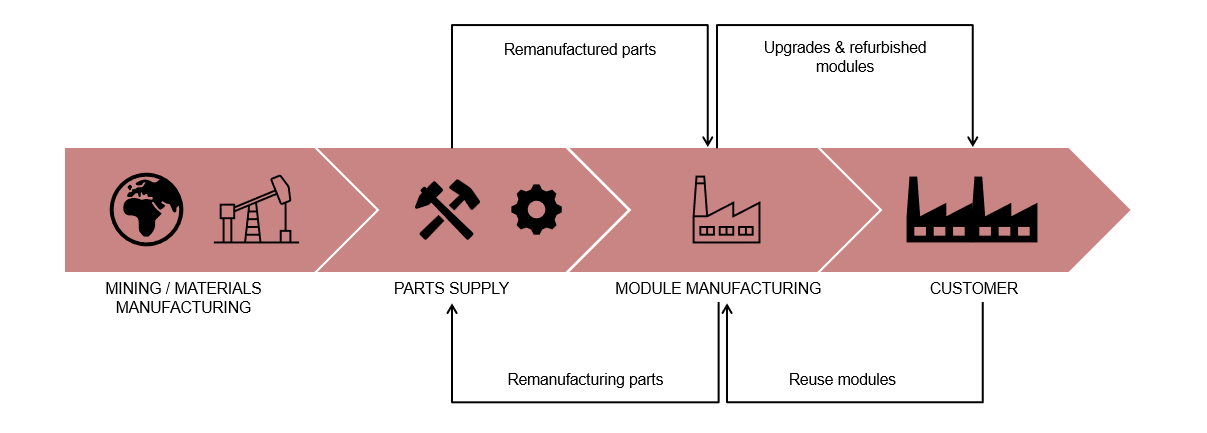
However, integrating reuse or remanufacturing into existing manufacturing operations also brings challenges. One of the main barriers companies face is the potential disruption to their current production flows, which often them from implementing reuse strategies, despite the long-term value they offer.
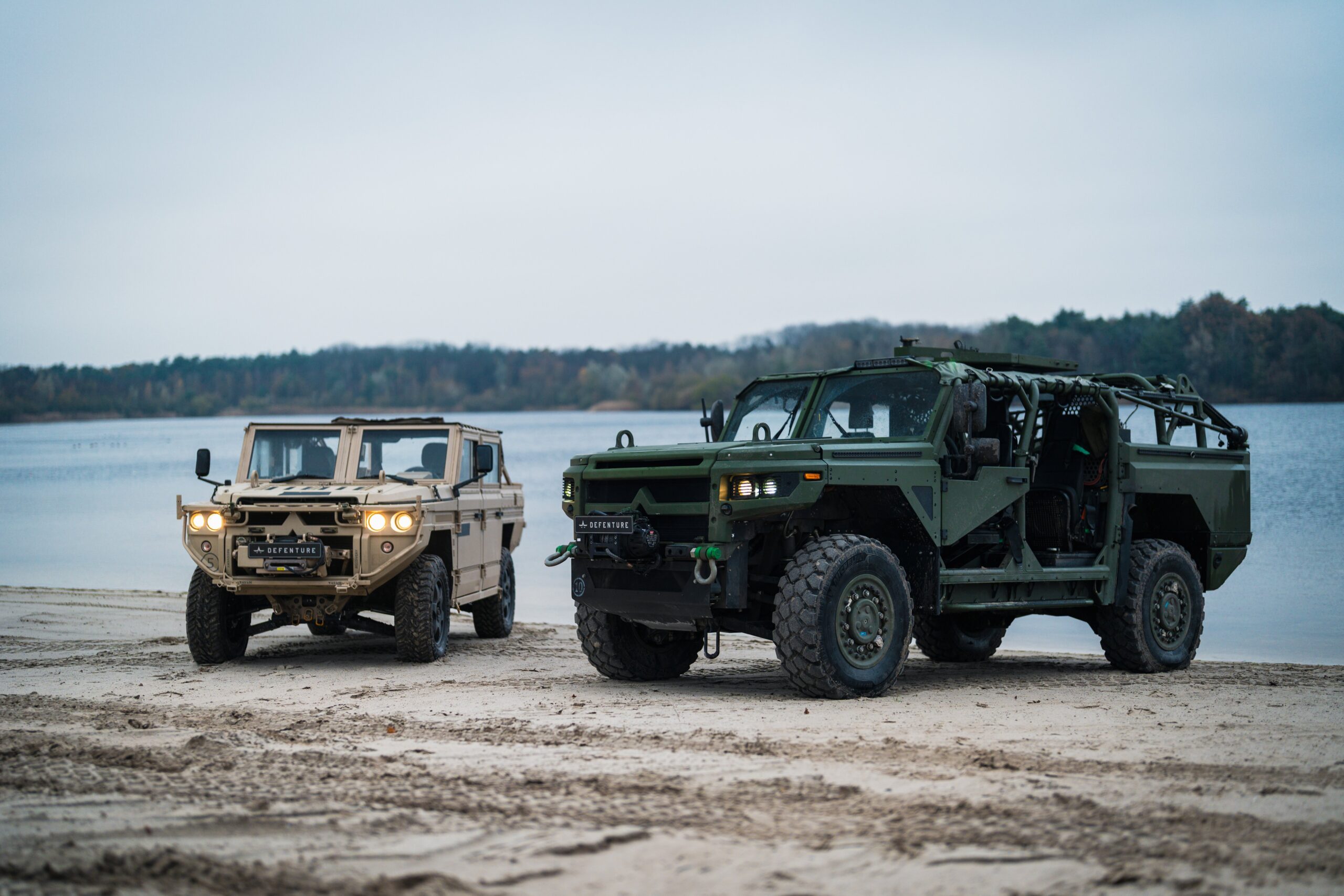
Supporting Defenture in scaling their defense production line
Nobleo Manufacturing has recently joined forces with Defenture, a Dutch company specialising in high-quality light tactical vehicles for defense and security applications. Together, we are supporting the scale-up of their defense production line.
Project
The aim of this collaboration is to support Defenture in scaling up its production further. Defenture’s expected growth has created a need for a new production line to support the company’s increased production volume while ensuring an efficient, scalable process.

A scalable production line for defense manufacturing
To support Defenture in developing a new production line, Nobleo Manufacturing uses the Manufacturing Development Process (MDP). This structured method involves developing, evaluating and refining a production concept step by step until it is ready for implementation. Various phases are undertaken within this process, during which concepts are devised, analysed and optimised.
Process planning for defense production capacity
Process planning is an important part of this approach. This method involves calculating various scenarios to enable Defenture to gain insight into the required production capacity and associated production footprint.
Factory layout and logistics design
In addition to production processes, the Manufacturing Development Process examines other aspects of the factory, such as:
- Logistics flows within the factory
- The structure of the value chain;
- The IT systems required for production and logistics.
All developed concepts will ultimately be brought together in a 3D visualisation of the factory layout. This visualisation provides a comprehensive picture of the future production facility, including:
- Production areas
- Warehousing and storage
- Logistics routes
- Support facilities
Towards an efficient and scalable production facility
The end result is a well-founded concept for an efficient and scalable production line that aligns with Defenture’s future production ambitions.
Scaling up production is complex, whether you are in defense, high tech or any other industry. If you are facing similar challenges around production capacity, factory layout or process planning, we would be glad to explore what the Manufacturing Development Process could look like for your organisation. Feel free to get in touch.
Achieving New Level Manufacturing Together
If you are facing similar challenges around production capacity, factory layout or process planning, we would be glad to explore what the Manufacturing Development Process could look like for your organisation.
Let's Optimise Your Business!
No commitment, just a conversation. We will get back to you within two business days.
How to improve quality assurance with a Quality Roadmap
A year ago, Iris Janssen, Industrial Engineer at Nobleo Manufacturing, started with an issue that came up with the customer: how do we ensure structural quality improvements instead of solving ad hoc problems? That became the start of a process that involved working with the customer on a 5-year (long-term) strategic quality roadmap, linked to the business strategy. The quality roadmap acts as a practical tool for quality assurance services in production, enabling continuous improvement, customer focus, and operational excellence.
Background: what is a quality roadmap?
A quality roadmap is a strategic plan that guides overall quality improvement, process optimisation and culture change, Iris explains.
“We analyse the current situation and identify improvement opportunities. Based on the results, we prioritise these improvement opportunities, considering the business objectives. We then coordinate the planning and priorities with the client and provide advice.”
Iris Janssen – Industrial engineer – Iris Janssen – Industrial engineer
An annual plan then emerges from the quality roadmap, reflecting the priorities, schedule and deliverables for that year.
Proces quality roadmap
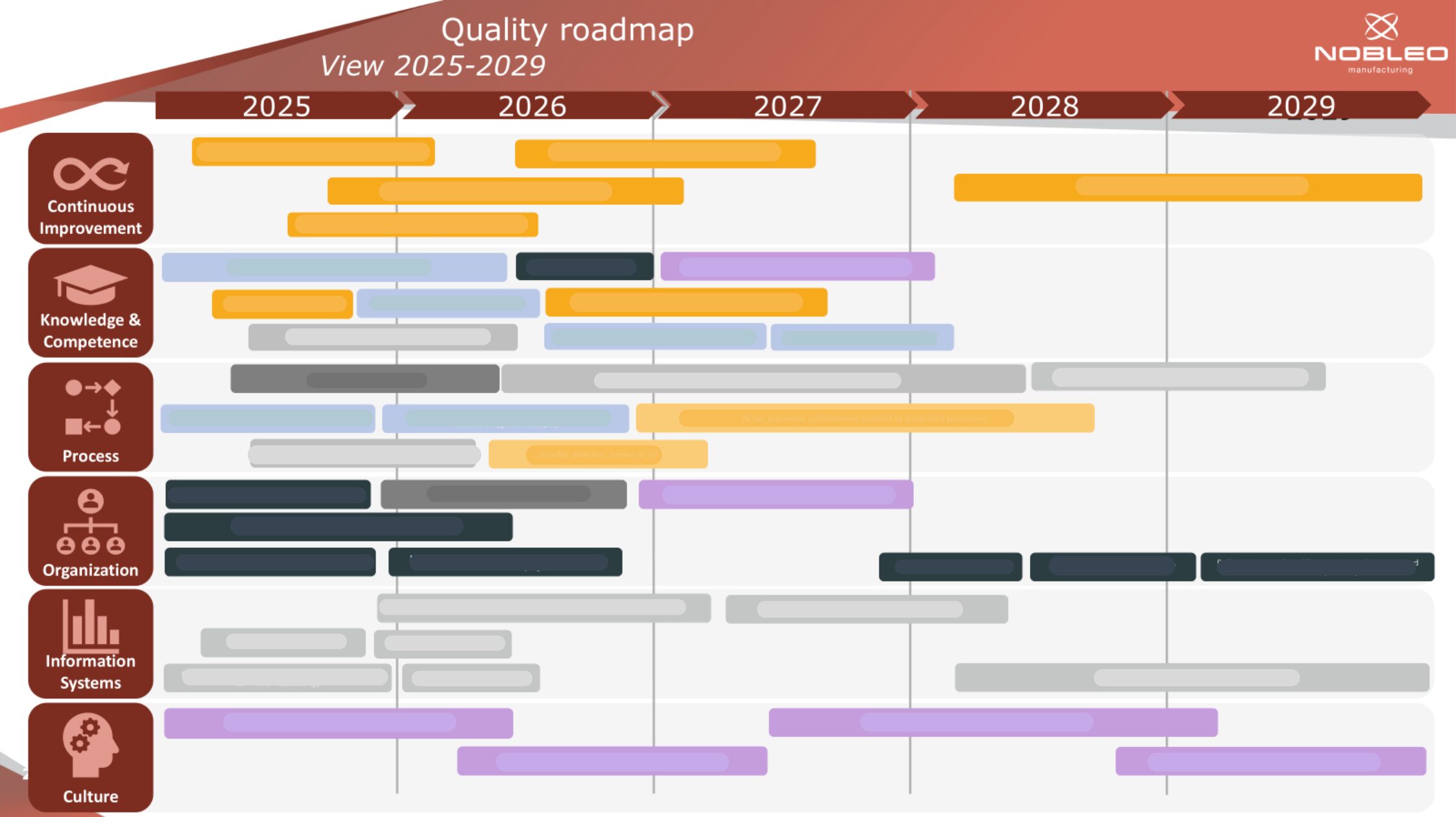
The Quality roadmap serves as a multi-year plan. First, the goals per year are defined; where do you want and can you be as a company in 1, 2 or 5 years. With these goals in mind, different projects are defined. These are divided into six categories, drawn up in cooperation with the customer.
- Continuous Improvement
- Knowledge & Competence
- Process
- Organisation
- Information Systems
- Culture
For each category, projects are plotted that are divided into eight different programmes, including; Quality Culture, Performance steering and digitisation, New Product Introduction and N-tier management.
Challenge
An important part of the process is setting the right priorities. The risk is that you want to tackle too much at once, while time and capacity are limited. The roadmap helps to take a step back, create overview and focus.
Co-creation and co-ownership
At Nobleo Manufacturing, we always guide this process in co-creation and co-ownership with the customer. We not only determine together what is really important, but we also take joint responsibility for the implementation. This shifts the focus from daily operational issues to achieving structural and sustainable improvements.
Future
At Nobleo Manufacturing, we aim to develop a generic Quality Roadmap that helps organisations systematically improve their quality levels. A roadmap of this kind helps companies to deliberately map out where they currently stand in terms of quality and where there is room for improvement. Based on this, priorities can be set and targeted improvement programmes can be rolled out.
This structured approach offers organisations a clear starting point, highlighting areas for improvement and providing direction for targeted quality growth. At the same time, it fosters alignment across all levels of the organisation by uniting efforts around shared goals and priorities.
Why Nobleo
What sets Nobleo Manufacturing’s approach apart is the combination of practical experience, process insight and long-term thinking. Nobleo works with different companies in various sectors, enabling quick recognition of what is going on and what is needed.
A key aspect is that this is always done in close cooperation with the customer. Not as an external consultant from a distance, but as a sparring partner who thinks along, challenges and builds solutions that work together. The focus is not on treating symptoms, but on preventing recurring problems.
The ultimate goal? An organisation in which quality is not a department, but a mindset.
Are you curious about how a quality roadmap can provide more structure and quality improvement in your organisation? Contact us, we are happy to think along with you.
Achieving New Level Manufacturing Together
I’m here to help you find the role that fits your talent and ambition.
Let's Optimise Your Business!
No commitment, just a conversation. We will get back to you within two business days.
Implementing reuse in manufacturing
Sustainability, material scarcity and energy consuming manufacturing processes are accelerating the transition from a linear to a circular economy. This shift is not only essential for the environment but also presents a strategic opportunity for cost savings and business resilience. Practices such as reuse , remanufacturing, recycling and refurbishing provide a solution. By reusing materials and components, companies can reduce dependency on scarce resources, cut costs, and contribute to a more sustainable world.
Challenges
Nobleo's approach
This is where Nobleo Manufacturing comes in. Through our specialised engineering services, we support companies in adopting and embedding reuse strategies into their operations, without compromising productivity. Our know how of manufacturing processes allows us to help clients effectively configure essential processes such as ERP system integration, incoming inspection, disassembly, cleaning, and requalification. By doing so, we help turn reuse into a structured and scalable part of everyday manufacturing.
“Our know how of manufacturing processes allows us to help our customers turn reuse into a structured and scalable part of everyday manufacturing.”
Rik Peeters – Industrial engineer – Rik Peeters – Industrial engineer
What does our approach look like
- We guide the analysis and help prioritise high-impact reuse opportunities, tailored to your operations and product architecture.
- We help design and implement reuse loops into your existing operations and configure your ERP systems and workflows accordingly.
- We support the development of supplier strategies and coordinate pilot programs to validate reuse processes in real-world settings.
- We co-create and implement standards for reuse, ensuring control, traceability, and long-term reliability of reuse strategies.
Curious how reuse can contribute to cost savings and sustainability within your organisation? Let’s explore the possibilities together. Contact us today to see how we can support your transition toward a more circular and efficient manufacturing process.
Achieving New Level Manufacturing Together
I’m here to help you find the role that fits your talent and ambition.
Let's Optimise Your Business!
No commitment, just a conversation. We will get back to you within two business days.
Reusable packaging solutions for a more efficient and sustainable supply chain
As a Manufacturing & Logistics Engineer at Nobleo Manufacturing, Philip Reichert has spent the past seven years tackling complex projects across the manufacturing industry. Working in such diverse environments has been incredibly rewarding. "You constantly need to bridge the gap between technical complexity and logistical efficiency," Philip explains. Over the years he has developed a clear view of how reusable packaging solutions in logistics contributes to a more efficient and sustainable supply chain, a theme we explore in this article.
Special packaging goes beyond boxes and crates
Philip does not consider himself a packaging specialist. However, throughout his career, he has frequently worked with special packaging.
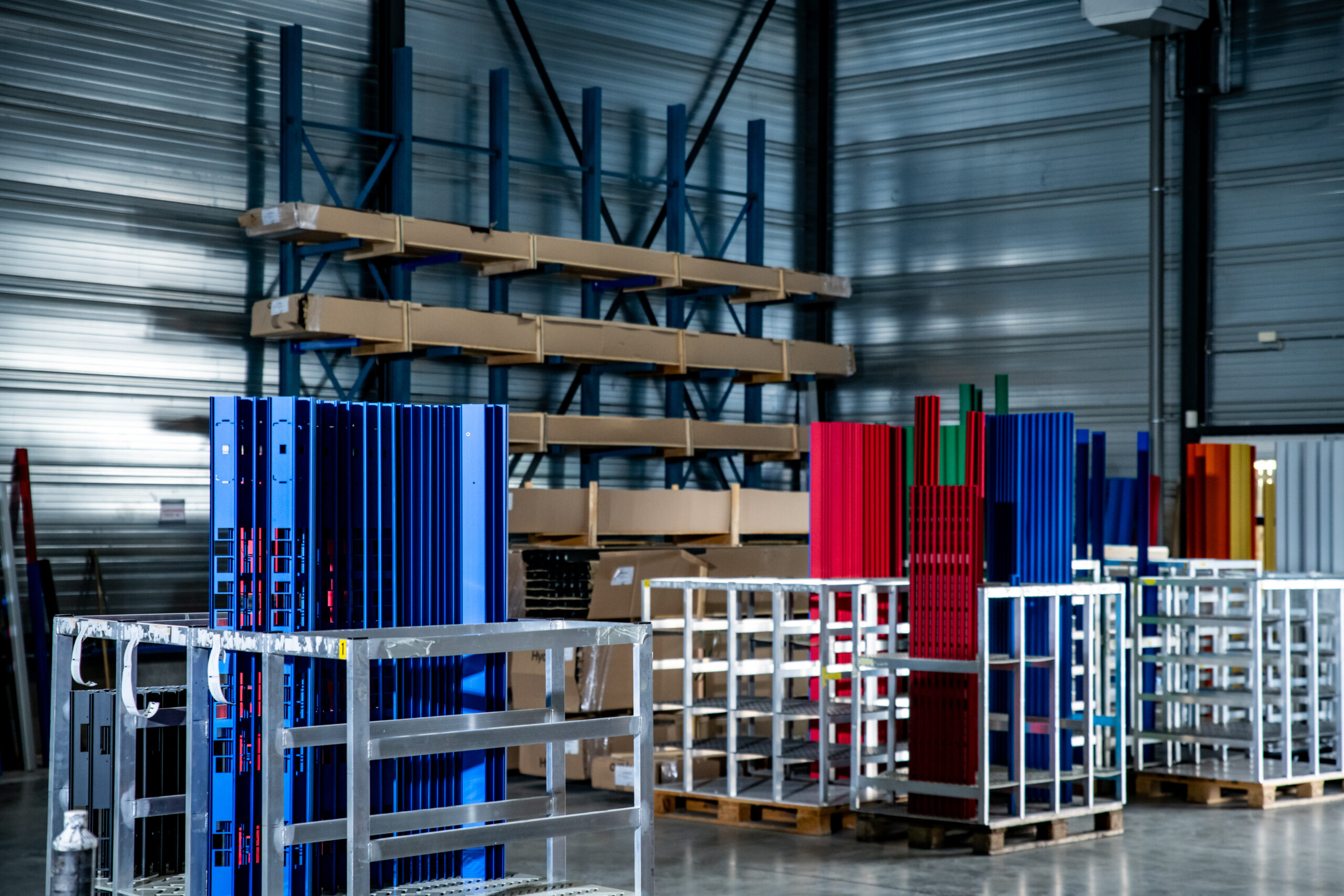
“Special packaging goes beyond the traditional cardboard box. It refers to packaging specifically designed for reusability and optimal protection of vulnerable products.”
Philip Reichert – Manufacturing & Logistics Engineer – Philip Reichert – Manufacturing & Logistics Engineer
Packaging can broadly be divided into standard and special packaging. Standard packaging is typically used once, while special packaging is often reusable and sustainable, which brings considerable cost benefits. This special packaging can take various forms, such as reusable metal cages, EPP (expanded polypropylene) trays, and textile solutions. Each type of packaging is customised to protect a specific product and optimise the logistics chain.
For components that must meet high cleanliness and protection standards during transport and storage, such as in the automotive industry, these solutions are essential. In Philip’s projects, specific packaging was designed for components like the grille of a truck. Through close collaboration with the client and suppliers, not only the design of the packaging was optimised, but also the production and implementation in the supply chain. Over the years, Philip has seen how intelligent packaging contributes both to product quality and to overall efficiency in the logistics chain.
Sustainability and cost savings go hand in hand
Nobleo places a strong emphasis on sustainability. Reducing waste streams and reusing materials is therefore a key aspect in the development of special packaging. For instance, Philip has worked with suppliers to take back and recycle broken EPP trays, a step towards a circular economy.
“Sustainability is the future of special packaging. By using reusable materials and innovative designs, such as EPP and textiles, we can reduce the ecological footprint of the industry.”
Philip Reichert – Manufacturing & Logistics Engineer – Philip Reichert – Manufacturing & Logistics Engineer
The efficient use of transport, smart tool and sustainable packaging also offers real cost benefits. By making the right choices in the logistics chain, companies reduce their ecological footprint and save on unnecessary expenses at the same time. At Nobleo Manufacturing, we keep looking for ways to help our clients optimise these processes.
Curious what reusable packaging could mean for your supply chain? Get in touch, we are happy to explore what is possible.
Achieving New Level Manufacturing together
Whether you want to reduce waste, cut logistics costs or make your packaging reusable, we are happy to think along. No commitment, just a conversation.
Curious what reusable packaging solutions could mean for your supply chain?
No commitment, just a conversation. We will get back to you within two business days.
Lineside Engineering: bridging the gap between production and logistics
In the world of manufacturing and logistics, efficiency is crucial. One way to increase the efficiency of a factory is through Lineside Engineering. This approach enables companies to transform the way they manage their production processes and production lines. In this article, our Lineside Engineering expert, Kevin Messak, explains the concept.
Why Lineside Engineering?
In the realm of assembly, efficiency is becoming increasingly crucial. Customer demand is constantly rising, necessitating companies to be flexible in order to swiftly respond to the market. This can lead to situations in the manufacturing industry where production lines need to be reconfigured, resulting in suboptimal processes and spatial constraints. Consequently, this leads to increased logistical costs. Additionally, introducing a new product into an existing production line or setting up a new production line requires an efficient approach. Lineside engineering provides a solution for these challenges.
The basics of Lineside Engineering
Lineside Engineering is more than just a concept; it is a versatile strategy aimed at redefining the relationship between the production floor and the logistics department. At its core, it revolves around the idea that space optimization and process efficiency can enhance the entire production cycle.
To achieve this, consideration is given to the sequence in which materials are used and how production workers prefer them to be presented, all while taking logistical costs into account, the so-called Line Back Principle. In practice, we sometimes see production engineers designing the layout of the production line without a thorough logistical approach. This can result in complex Linesides where logistical issues are overlooked.
How does it work?
The first step is to carefully collect and analyze data. This phase focuses on understanding the existing layout, materials, and processes. For the successful implementation of Lineside Engineering, this step is crucial.
Subsequently, the success of a Lineside Engineering project heavily depends on teamwork. Ideally, a team consists of experts from various functions and, perhaps most importantly, an operator or team leader from the production line. Roles that are important in a successful Lineside Engineering project include Process Engineer, Manufacturing Engineer, and Logistics Engineer. A Lineside Engineer takes a guiding role and collaborates with the team to find solutions for improvements in the process flow. Within Nobleo Manufacturing, we possess the necessary competencies to successfully complete such a project.
Implementing a Lineside Engineering project inevitably brings about change. Changes typically encounter resistance, especially from operators on the production floor who are accustomed to their routines. The key is to involve them in the process. The insights of the operators are invaluable; they understand their workstations the best. Their feedback can lead to changes that significantly enhance efficiency. Our engineers, through years of experience, know how to address this resistance to change and can assist an organization in successfully completing the project.
When dealing with complex Lineside Engineering, we also utilize simulation tools. Simulations aid in determining the most efficient configuration for the production line. For example, we can consider various scenarios: what if we have less bulk storage? What if we change the scale of the operation? Simulating these options provides valuable insights and can help the organization in convincing stakeholders of the proposed improvements.
Duration of Lineside Engineering Project
The duration of Lineside Engineering can vary depending on the project’s complexity and the level of collaboration. In some cases, a project can be completed within four weeks, while others may take several months. The degree of support and engagement from the client is crucial in this aspect.
Improving process flow: practical examples
Lineside Engineering has led to significant improvements in process flow for various clients of Nobleo Manufacturing. For instance, at one of these clients, materials were positioned on both sides of the production line, hindering visibility and consequently efficiency.
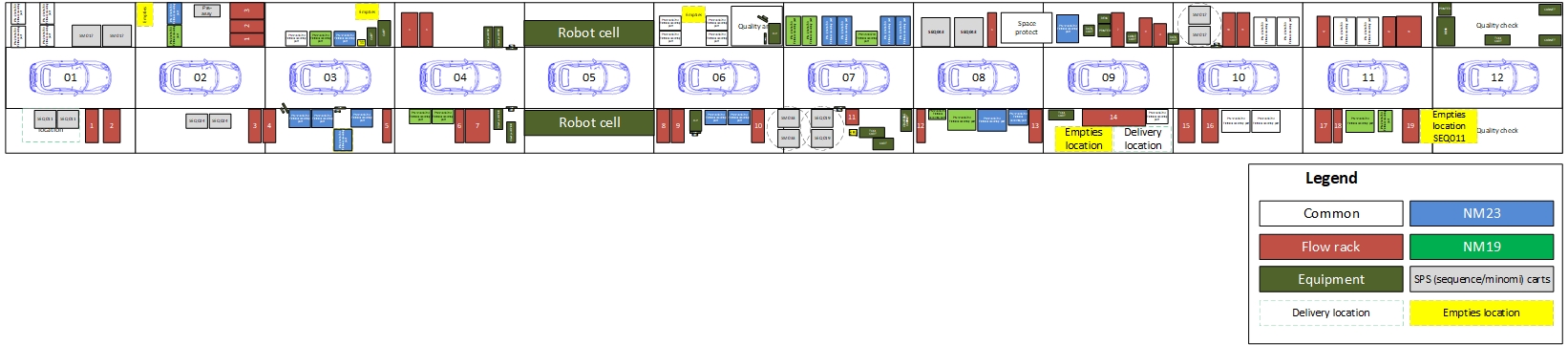
The Lineside Engineer started by inventorying the necessary materials and optimising their packaging. By adjusting the layout of the flow racks, fasteners were moved to both ends of the production line. This allowed employees to access all necessary materials from these flow racks at the beginning of their shifts, resulting in substantial space savings per workstation. Costly kitting processes were eliminated by bringing them back to the production line. This approach demonstrates how a logistical approach can significantly enhance space efficiency.
The concept of Lineside Engineering is not only relevant to this manufacturer but can also be applied to other companies. Regardless of their industry, businesses can implement Lineside Engineering to optimise their own logistical and production processes. The goal is to achieve space efficiency and process improvement, which can be crucial for companies with limited space and the need for continuous improvement.
Lineside Engineering: a path to transformation
Lineside Engineering is a transformative approach that enables companies to create a seamless fusion between production and logistics. It allows us to identify and correct inefficiencies, reduce waste, and improve overall productivity. The collaborative nature of Lineside Engineering fosters a culture of continuous improvement.
With practical insights and a hands-on approach, Nobleo Manufacturing offers a comprehensive solution to make your production process more efficient and effective. By reducing logistical waste and optimising process flow, costs can be saved, and growth can be more easily achieved.
This is a fictitious case study illustrating how the layout of an assembly line was adjusted after the application of Lineside Engineering. Remember, Lineside Engineering is not just about optimizing space; it’s about transforming your approach to production. So, are you ready to take the first step towards a more efficient and innovative future in manufacturing?
Wondering how this approach could work for your business? Contact us, we’d love to explore it with you.
Let's Optimise Your Business!
No commitment, just a conversation. We will get back to you within two business days.
Introducing: Project logistic engineering in a Lean Assembly environment.
We would like to introduce you to Jeffrey Mussche, Industrial Engineer & Data Scientist at Nobleo, currently working at VDL Smart Spaces among other projects.
About Jeffrey
Over a year and a half ago, I graduated from Eindhoven University of Technology in Operations Management and Logistics and started working at Nobleo Manufacturing. As an Industrial Engineer & Data Scientist, I have been involved in multiple projects and have gained experience in both data and logistics. With this experience, I embarked on a project at VDL Smart Spaces, formerly known as VDL Bus. It is an interesting project where the preparation and acquisition of the right data, form the foundation for solving larger logistic issues.
About VDL Smart Spaces
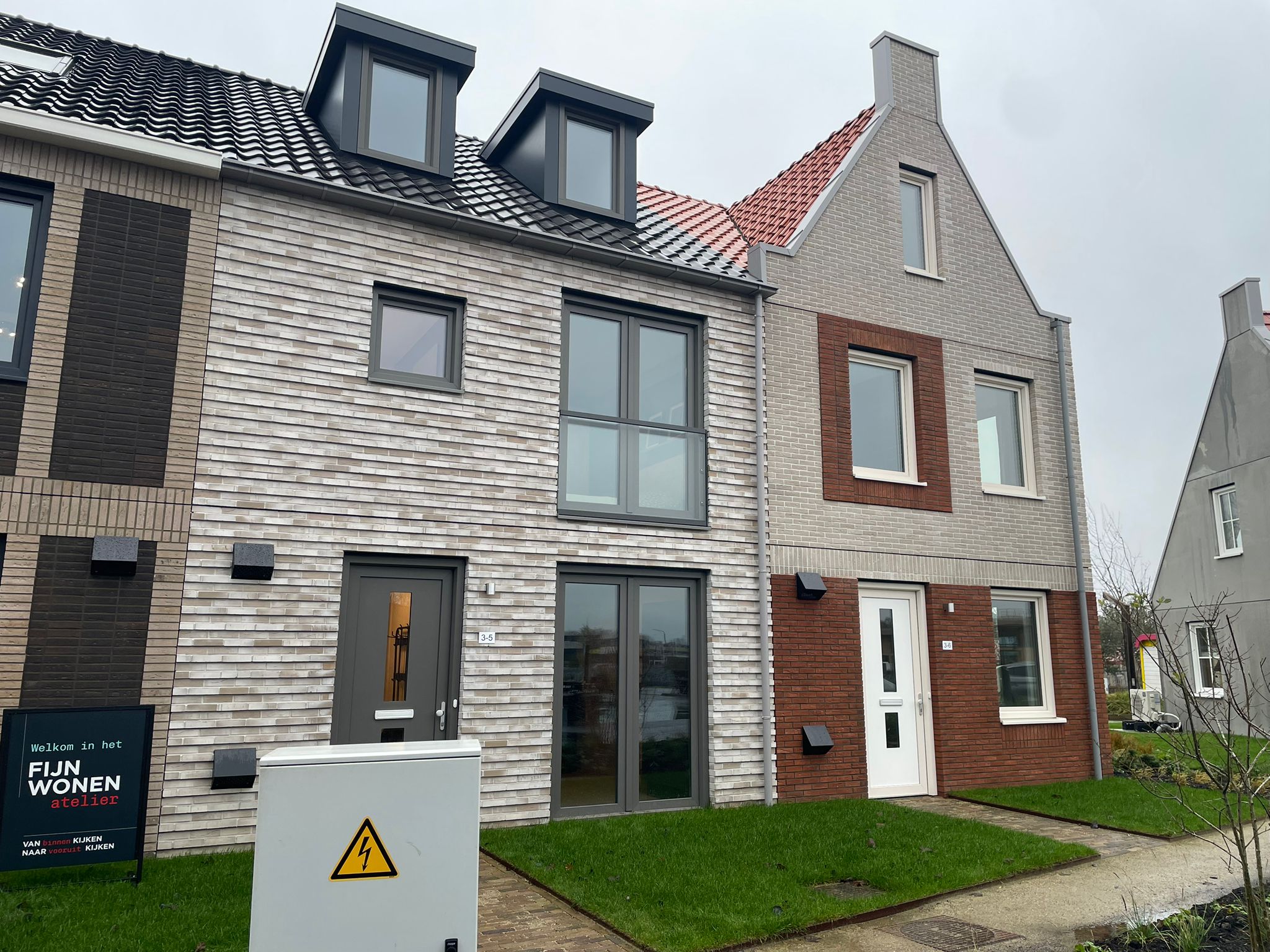
In recent years, the demand for housing in the Netherlands has significantly increased, while the availability of affordable options has not. To address this, VDL and Van Wijnen combine their expertise in industrialization and construction to find a solution for the housing shortage. By producing industrialized building modules, the construction time of a house on-site can be significantly reduced from approximately 60 days to just 24 hours.
For VDL Bus in Heerenveen, this resulted in a complete shift from building buses to constructing modular bathroom modules. A transformation in which Nobleo Manufacturing was brought in to take on the logistic engineering in a lean assembly environment. A new production line requires a seamlessly integrated logistic process. Nobleo supports both the physical logistics (line supply, packaging and delivery strategy, layout, transportation, etc.) and the control logistics (preparation of master data, automation of administrative tasks, implementation of SAP, etc.) for this development. Nobleo’s experience in developing logistic processes in the automotive industry greatly contributes to the logistic implementation.
This is an interesting challenge where I can apply my acquired knowledge in practice and be part of the Nobleo project team alongside Peter Lempke and Peter Thissen.
Wondering how this approach could work for your business? Contact us, we’d love to explore it with you.
Let's optimise your business!
No commitment, just a conversation. We will get back to you within two business days.