Meet project Audit & Improve at Schleifenbauer by Edward Goudsmits
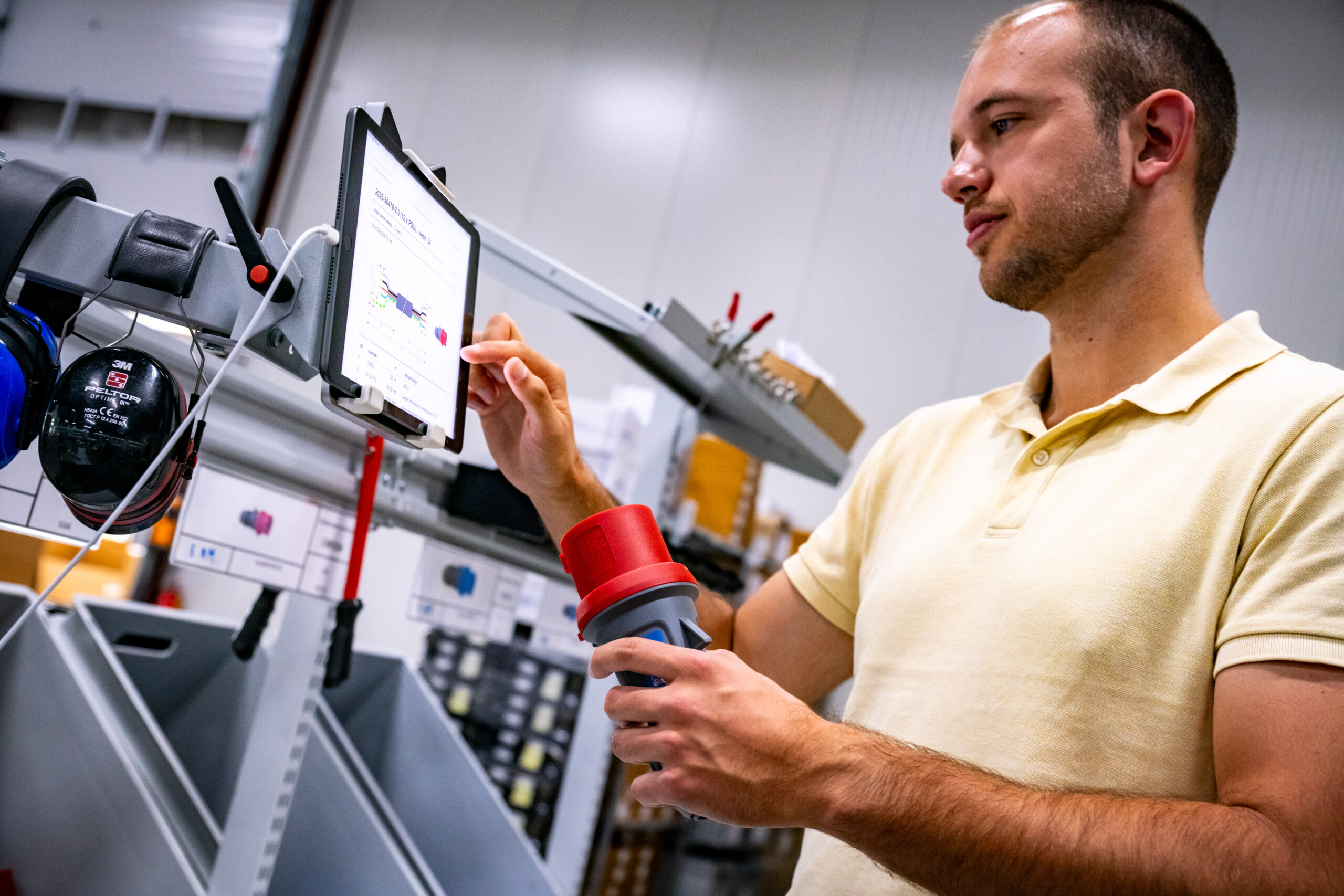
Edward Goudsmits, lead Audit & Improve, has been working at Schleifenbauer on behalf of Nobleo Manufacturing. There he works on Audit & Improve project cycles.
About Edward
The project at Schleifenbauer is perfect for me. I once read the quote “You can’t manage what you don’t measure”. My background in Industrial Engineering & Management taught me that “to measure is to know”. I developed Audit & Improve (A&I) based on this principle, among other things.
My strengths are my analytical skills and my soft skills, such as dealing with people and creating an environment where people are open to change. Thanks to the A&I approach, we stick to the facts (using measurement). Employee input is essential. They get involved in the A&I process by sharing what they think could be improved. This, over time, creates support for improvements.
Furthermore, my experience in the quality field is very valuable, as this was originally Schleifenbauer’s strongest need. From the point of view of quality, we are now also tackling the processes of logistics, operations and purchasing. The approach here has already resulted in a different operations structure and the addition of visual management at various process steps.
About Schleifenbauer
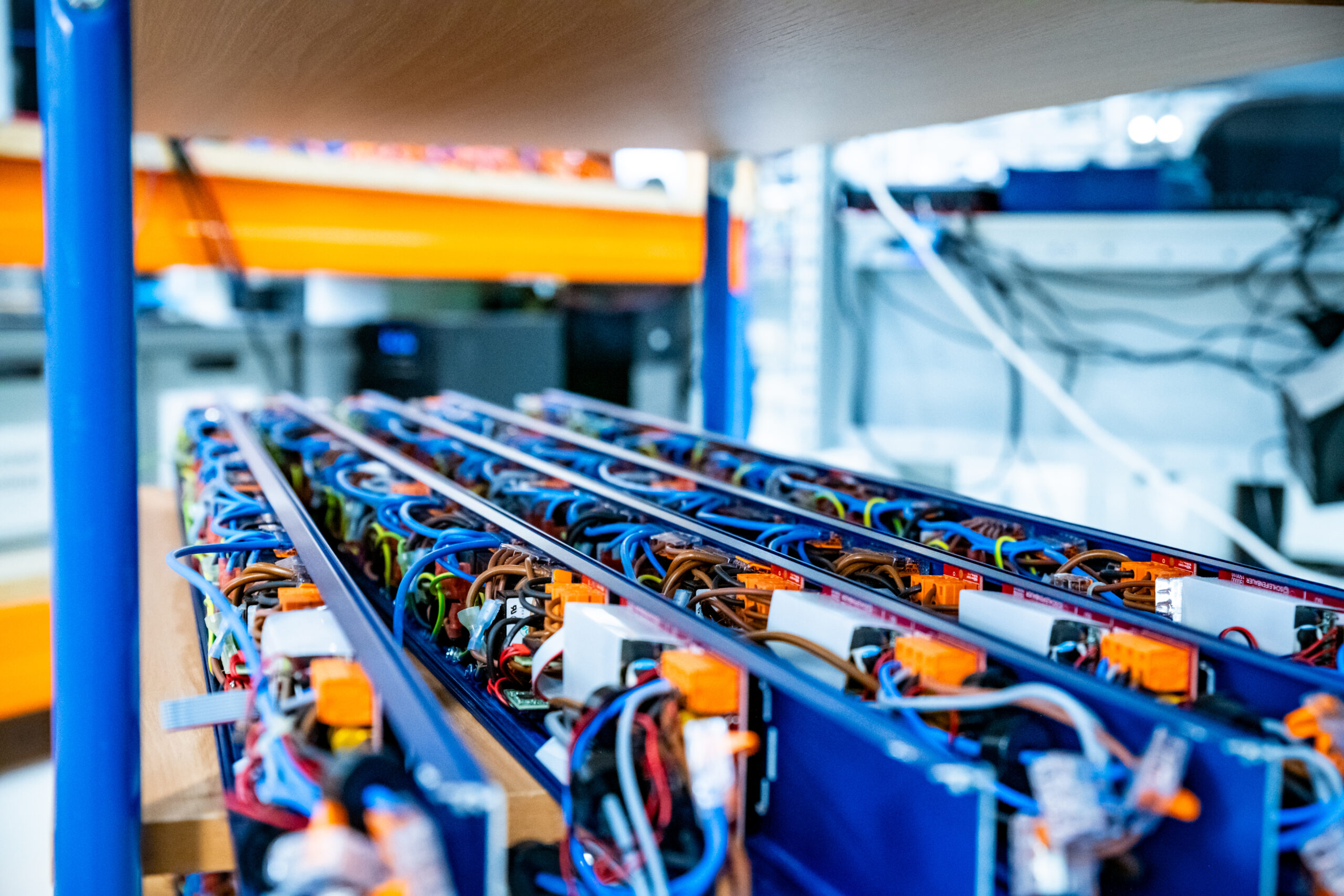
Schleifenbauer is a manufacturer of Power Distribution Units (PDUs), based in Den Bosch. Their strength is the production of custom-configured PDUs, with a delivery time of several weeks. Scaling up the production capacity due to the increasing demand from existing customers and the extra demand from new customers required a broad project approach in which quality is of paramount importance.
About Audit & Improve
With the Audit & Improve project approach of Nobleo Manufacturing, a menu of improvement opportunities was presented after the first scan and audit. After the first round of selecting the improvement potentials, the first improvement cycle started. After realizing the promised results at the end of an improvement cycle, the menu was put back on the table. This way, Nobleo Manufacturing and Schleifenbauer work closely together to realize cycles of improvements for production and logistics, customer support, quality and the quality management system.
Wondering how this approach could work for your business? Contact us, we’d love to explore it with you.
Let's Optimise Your Business!
No commitment, just a conversation. We will get back to you within two business days.
Sankey diagrams for a clear view on flow
Managing your supply chain and inventory management has become especially relevant in the current crisis with suppliers facing new challenges due to new economic landscape and closing of borders.
Objective
To maximize your added value in the manufacturing industry, it is necessary to look into your logistic flows. This means minimizing stock and warehousing and creating as much flow as possible. Often, what is missing is a clear overview of the processes that allows you to direct your attention to the flows where the biggest potential impact can be achieved. Nobleo has developed a tool that helps determine exactly that, by creating insight in your logistic processes.
Approach
The Sankey tool combines data from multiple aspects in your organization, from demand to packaging and presents a straightforward depiction of the logistics in your company. Combined with our experience in the automotive sector, this can be used to save vast amounts of money due to less unnecessary handling and storing of parts and products.
Result
The Sankey diagram is the foundation of optimizing your logistic processes; both internal and external flow as well as manning can be calculated bottom-up to provide insight in the potential for efficient operation of your company.
In these corona times, reshoring, alternative or additional supply chains creates an urgency of a comprehensive and up-to-date overview of inventory management, for which Sankey is an excellent tool.
Wondering how this approach could work for your business? Contact us, we’d love to explore it with you.
Let's Optimise Your Business!
No commitment, just a conversation. We will get back to you within two business days.
5S + 1 implementation
An internationally operating warehousing company with various locations in Europe and the rest of the world.
Objective
Applying a basic structure with a lower limit with respect to order and cleanliness and visual management in the various public warehouses and offices. This is done according to the 5S+1 Lean philosophy.
Approach
The first step was ensuring a good baseline in which old lines and labels on racking were removed. After that, new banners, rack locations and staging location signs were applied company-wide. In personal discussions with the various operations managers and business unit directors, the steps were discussed and implemented.
Results
A good foundation has been laid on visual management with, among other things, a Campus wide visual management document and a first set-up to use visual management signs. Employees and line managers have been trained 5S+1 and training materials have been made available for temporary workers to ensure the 5S+1 culture at all levels. A good, frequent consultation structure with operations managers and the Quality and the Health and safety department has been ensured. Gemba walks were started, in which management members were invited to join the rounds to reduce the gap between the shop floor and the office. In addition, a start has been made to standardize the workspaces. A clean desk policy has been set up for a number of office departments, where input from employees was an important success factor.
Wondering how this approach could work for your business? Contact us, we’d love to explore it with you.
Let's Optimise Your Business!
No commitment, just a conversation. We will get back to you within two business days.
Operationalising proto-build to serial production
Our client specialises in the engineering, modeling and analysis of the latest generation technology. They are known for their top-class equipment that enables to master critical conditions in the application of advanced technology.
Objective
In the run-up to our assignment, the client went through a detailed NPI process to realize a number of high-tech proto modules. These were intended for a major player in the chip industry. As a result, the customer rewarded our client with an order for the serial production of these proto modules. The NPI process, and the establishment for serial production, were also realized under the supervision of one of our own Process Engineers.
The above resulted in a multidisciplinary assignment (Operational Control and Process Improvement) with the following project goals; increase move-rate production, guarantee output (QLTC) and optimise the project organisation.
Because, among other things, there was little insight into the customer long term demand, a sudden move-rate increase led to the necessary output problems at the beginning. Some examples; supplier delivery times under pressure, frequent production stops, staff fluctuations, increase in quality issues, etc. In short, in order to guarantee the physical output, the organisation of both project team and production process still needed to make some steps.
Approach
In order to guarantee the desired output increase, we initially shifted our focus to stabilising the current process (Operational Control).
The activities that we have unfolded were as following;
- Reviewing agreements with suppliers and customers based on forecast (demand & supply planning)
- Optimise planning tools for purchasing & production (MRP, Project and Shop floor planning)
- Secure the required competences by educating and training on the job
- Tackle quality issues based on impact and repetition (RCA, 8D)
Next we shifted our focus to make the process more manageable and improvable (Process Improvement). By organising a more KPI-driven process, among other things, possible waste in the field of QLTC now became visible. By using several Lean and Six-Sigma techniques (DMAIC, RCA, PDCA) we were able to improve and prevent future wastes.
Results
All this resulted in achieving the desired customer move-rate, with even room left for handling additional temporary move-rate increases. In addition, efficiency increased and a stable and flexible production organ was created. The FTEs that were unlocked can now manage the operation independently. After a short training session from our consultant they know what to do without losing the focus on the QLTC aspects. Finally, we have provided a blueprint for future serial proto-construction projects for our client.
Wondering how this approach could work for your business? Contact us, we’d love to explore it with you.
Let's Optimise Your Business!
No commitment, just a conversation. We will get back to you within two business days.
Coating Quality Improvement
Our customer designs, develops and makes an extensive assortment of innovative and high-end agricultural machines and services for global agriculture.
Objective
One of the agricultural machine production steps comprises of the coating of end-products. The powder coating quality does not comply to present and future standards and needs to be improved. To this end a new coating line needs to be implemented in an existing building, which is not fit for this purpose. The existing production capacity cannot be negatively affected while this change takes place or after. The coating capacity needs to be improved by 50% and the coating quality also needs to be improved. The new line needs to be fully prepared for future transfer to KTL coating (Kathodische Tauch Lackierung).
Approach
Nobleo Manufacturing has initiated and executed a complete program, in which the organization is guided to a defined and controlled project approach. An additional deliverable was to increase the company’s process management knowledge level. Supplier quality control has also been a key factor.
The methods and techniques used in this project are Project Management with a focus on the organization’s functionalities and the creation of organizational transparency.
Results
The old factory underwent infrastructural and constructional modification to create a dedicated coating facility, completing a new powder coating line within the time limit of 9 months and budget limit. The result was an autonomously operating organization on a higher knowledge level. During this changeover period, the old production process was demolished and the area was renovated, ensuring a seamless transition to the new operation process.
I’m here to help you find the role that fits your talent and ambition.
Let’s Optimise Your Business!
No commitment, just a conversation. We will get back to you within two business days.
Assembly Lead Time Reduction
This major Dutch healthcare equipment manufacturer assembles large and complex medical analysis systems to customer specification.
Objective
The extensive end-to-end assembly Lead Time results into high storage cost and allocation of working capital. This is caused by global sourcing including sea freight of the main component and on the other hand by large demand variability including market driven delays. On top of that the complexity of the assembly process itself plays a major role: i.e. links to sub-assemblies, inevitable regulatory and quality inspections and tests.
The key question was to reduce end-to-end on-site residence time and assembly lead time with focus on the supply chain of the main component and on the final system assembly.
Supply and demand of the main component are disconnected, leading to excess inbound buffer on one hand and late deliveries on the other hand. This also leads to overload of available storage capacity. The two phase assembly process causes inefficient transport of large and heavy equipment and lack of overview of status and whereabouts of work in process. Finally, interrupted assemblies lead to inefficient use of limited assembly station capacity, causing additional delay.
Approach and results
The way of working and communication with the overseas main component supplier have been improved, resulting in a reliable pull-based supply and 50% reduction of inbound buffer. Next to this a simple and clear visual tool has been developed to create overview of status and whereabouts of work in process, reducing transport and searching time. Using Lean concepts and tools, final assembly has been transformed to uninterrupted one-piece flow, decreasing lead time by more than half and increasing customer order flexibility. To enable this, assembly had to be transformed to a balanced multi station process, requiring introduction of a new tool for moving the heavy systems.
This also simplified operator tasks and increased workforce flexibility.
Wondering how this approach could work for your business? Contact us, we’d love to explore it with you.
Let’s Optimise Your Business!
No commitment, just a conversation. We will get back to you within two business days.