Using simulation as a solution for discrete manufacturing optimisation
Across the discrete manufacturing industry, companies face growing pressure to digitalise their planning and production environments to enhance their production control. This transformation is complex, but also full of opportunities. At Nobleo Manufacturing, we use simulation as an essential step, transforming complexity into clarity and supporting smarter decisions, whether for long-term investments or daily productivity gains.
Background: what is a simulation?
At Nobleo Manufacturing we use simulations to strengthen decision-making and create clarity in complex environments. Simulations provide valuable insights into both qualitative effects and quantitative effects, supporting companies in accelerating their digital transformation. In practice, this means that simulations can contribute to:
- Insight into the process and bottleneck analysis
- Smarter investment decisions
- Daily planning optimisation
- Improved productivity and efficiency
The challenge
In job shops, the routing between jobs is typically more complex and less structured than in flow shops, because each product may require its own unique sequence of steps, making optimisation a real challenge. Together with our clients, Nobleo Manufacturing uses simulation as a practical first step in digitalisation. By co-creating flexible solutions tailored to discrete manufacturing, we help develop or turn digital roadmaps into tangible improvements for daily operations and strategic choices for the factory.
Why Nobleo Manufacturing?
Within our Manufacturing Intelligence service, Nobleo Manufacturing has extensive experience in developing for flow shop environments, not as theoretical models, but as operational tools that are used on a daily basis. When linked to ERP and MES systems, the realistic simulation model becomes an operational tool supported by KPI dashboards for management.
What makes us effective is the combination of:
- Years of experience with logistical and operational challenges
- A deep understanding of the language and practice of manufacturing
- Knowledge of the discrete manufacturing industry and digitalisation
This unique combination enables us to successfully apply simulation in both flow shop and job shop environment, delivering solutions that truly work in practice.
Future steps
Our goal is to make the first general simulation blocks available in early 2026. This will lower the threshold for using simulation and make digitalisation more accessible to a wider group of manufacturing companies. To achieve this, we are working closely with knowledge institutes and partners in the Eindhoven region. By introducing simulation in job shop environments, companies not only take a step towards higher productivity, they also learn how to work with digitalisation in a practical, accessible way.
Conclusion
Simulation is more than just a tool, it is a bridge between today’s challenges and tomorrow’s opportunities. For job shops, it offers a clear and realistic first step in digitalisation. Nobleo Manufacturing combines practical experience with digital expertise to support companies in their digital transformation, from investment decisions to daily planning and productivity improvement. We are committed to making this step possible, together with our partners and customers. That is how we Achieve New Level Manufacturing Together.
I’m here to help you find the role that fits your talent and ambition.
Let’s Optimise Your Business!
Optimising manufacturing processes with a modified CRISP-DM approach
As Program Lead Manufacturing Intelligence, Berend Steenhuisen is involved in optimising manufacturing processes. In this process, he has also been involved in developing a Nobleo CRISP-DM variant (Cross Industry Standard Process for Data Mining). This is a widely used method in data science projects, where a structured approach is central. Data mining is a unique approach to Manufacturing Intelligence that Nobleo Manufacturing is engaged in.
The process of CRISP-DM
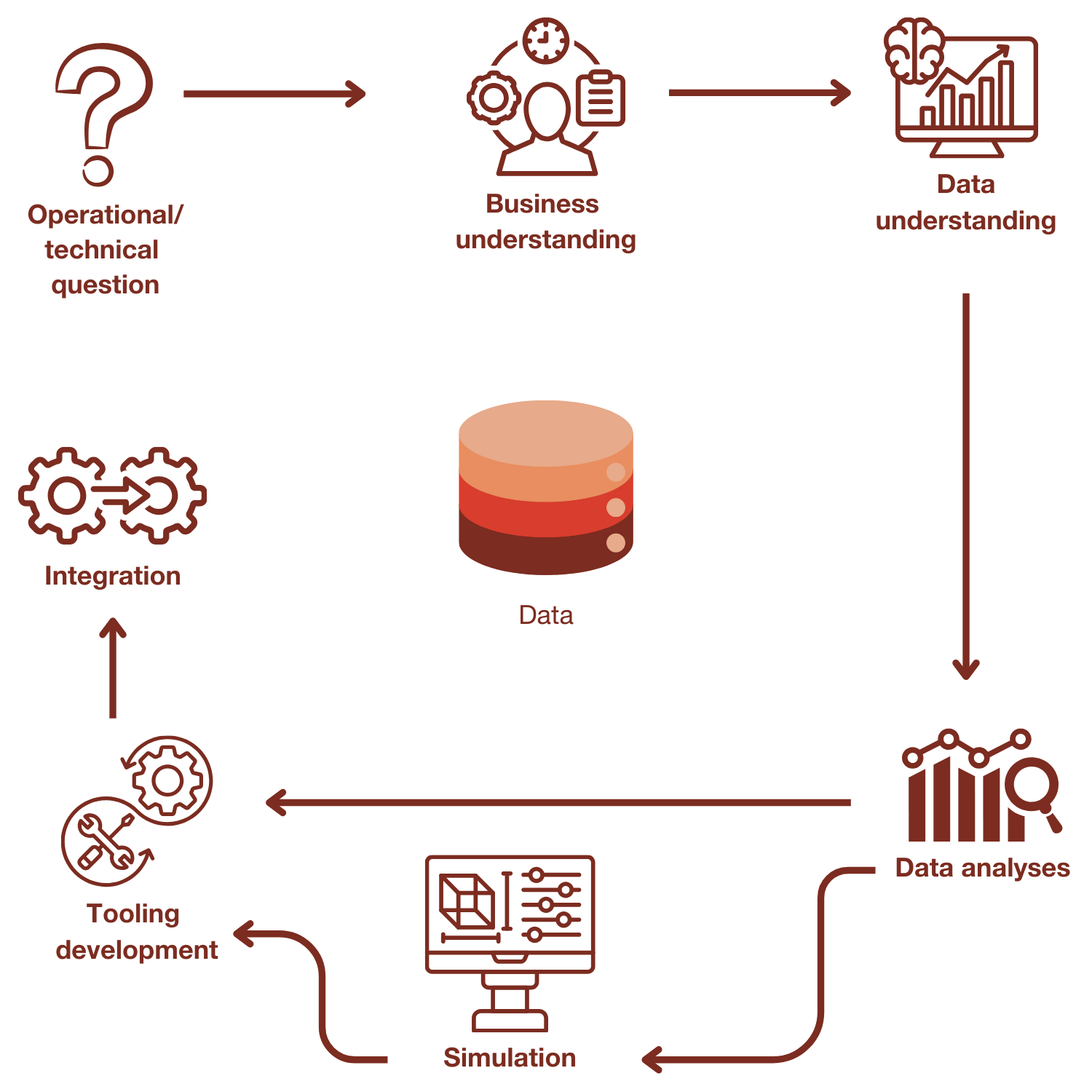
The Nobleo CRISP-DM process starts with business understanding, in which we delve into the customer’s needs and goals. To understand exactly what the customer wants to improve, understanding their business processes and their product is essential. Once this is well understood, we receive the data needed to move forward. This data forms the basis for the next step: data understanding. ‘In data understanding, we investigate whether the data is properly understood and interpreted,’ Berend explains.
This is followed by an initial data analysis in which we look at potential bottlenecks and where productivity can be improved. ‘The results provide us with valuable insights,’ Berend explains. ‘It tells us, for example, how many products can be made per day or which parts of the process can be made even more efficient.’
Based on these insights, the real development work is started, where, depending on the demand, a simulation is made or a useful tool is developed. With a simulation we can analyse deeper, and with a tool we give the customer the ability to repeat analyses themselves in the future without additional manual work.
‘The beauty of this approach is that we can always respond to what the customer needs now and in the future. Whether we provide a simulation or a tool, we make sure that the solution perfectly matches the customer’s goals.’
Berend Steenhuisen – Program lead Manufacturing Intelligence – Berend Steenhuisen – Program lead Manufacturing Intelligence
Future of CRISP-DM: AI and machine learning
The rapid rise of AI and machine learning is creating more and more opportunities for companies to optimise their processes and increase productivity. Within Nobleo Manufacturing, we see this as an opportunity to take our CRISP-DM process to the next level.
‘AI enables data analysis to be more efficient and faster, with increased accuracy that traditional methods cannot keep up with. Our approach with stage gates and regular feedback remains essential here, but with AI we have the ability to move even faster and tailor our findings even more closely to customer needs.’
Berend Steenhuisen – Program lead Manufacturing Intelligence – Berend Steenhuisen – Program lead Manufacturing Intelligence
Flexibility and cooperation with the customer
At Nobleo Manufacturing, we value a flexible approach and close cooperation with the customer. Berend explains how this works within the CRISP-DM process: ‘During the project, there are so-called stage gates, moments when the findings of each stage are documented and presented to the customer. This creates space for reflection and feedback, so that the project team and the customer are always on the same page.’
Nobleo Manufacturing’s strength also lies in its flexibility and ability to move quickly between projects. This allows us to respond effectively to customer needs and provide additional support where needed. ‘Our teams switch between projects, combining expertise from different disciplines,’ Berend explains. ‘This dynamic approach, together with timely feedback on our findings, add great value to each project.’
Want to know more about our expertise in CRISP-DM and optimising manufacturing processes? Contact Nobleo Manufacturing and find out how we can help your company.
Achieving New Level Manufacturing Together
I’m here to help you find the role that fits your talent and ambition.
Let’s Optimise Your Business!
Introducing: Project manufacturing order release scheduling
We would like to introduce you to Noël Krouwel, Industrial Engineer & Data Scientist at Nobleo Manufacturing, currently working with Van Wijnen.
About Noël
As a new employee at Nobleo Manufacturing, I was fortunate to join an interesting project. This project aligns closely with the direction I chose in my studies as an Industrial Engineering & Management: improving business processes and decisions using advanced analysis methods such as data analysis and AI. I completed my master’s degree in Operations Management & Logistics at Eindhoven University of Technology at the end of last year, marking the completion of my student years.
I have been with Nobleo for about 5 months now, working as an Industrial Engineer & Data Scientist. With fresh knowledge from university, I was able to immediately contribute to a project for Van Wijnen, a construction company involved in area and project development, renovation and transformation, housing construction, and real estate management. We are building a tool with the project team to help Van Wijnen determine an efficient production sequence to improve their throughput.
About Van Wijnen
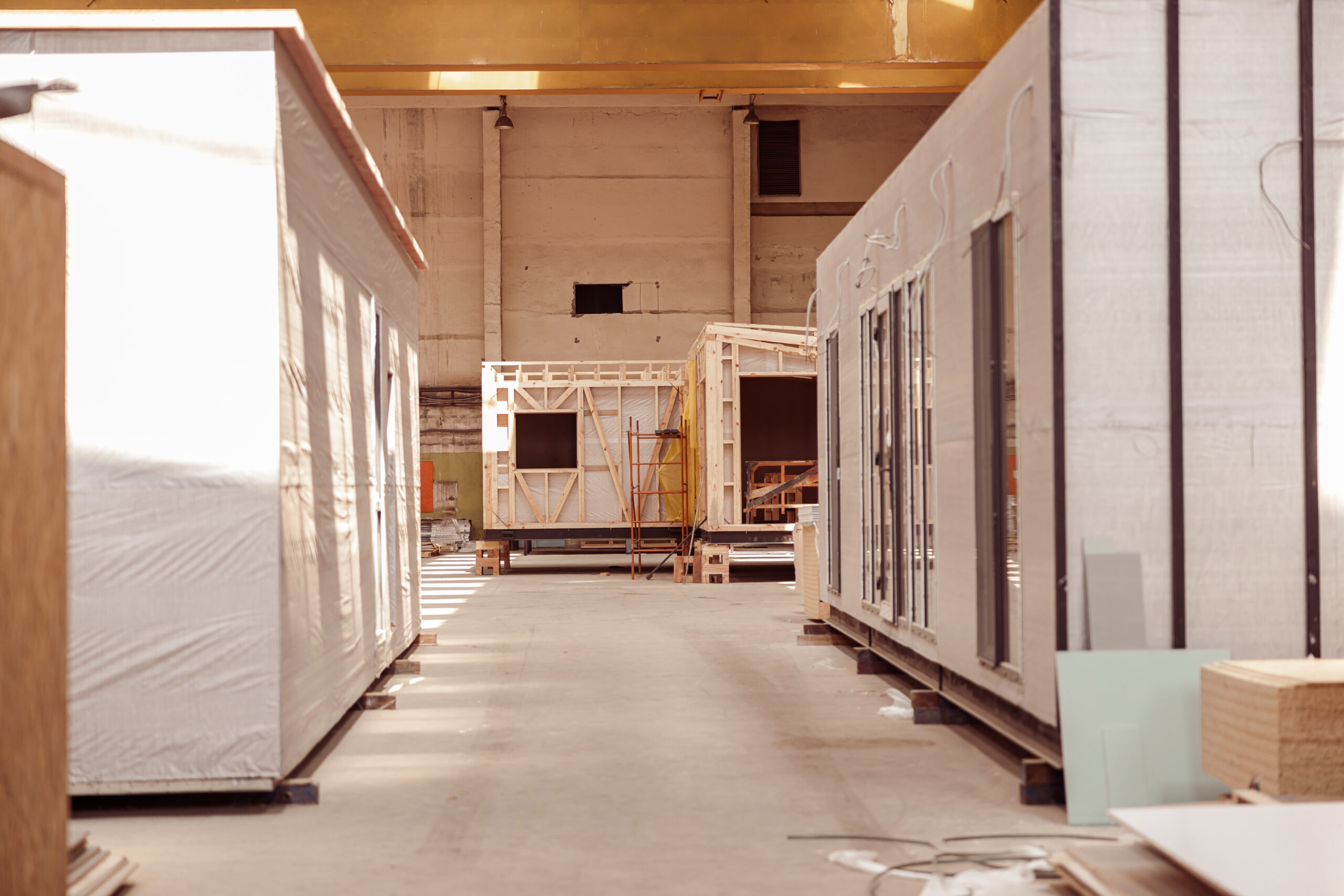
Under pressure from the housing shortage, scarcity of resources and labour, rising construction costs, and the importance of circularity and energy-neutral building, Van Wijnen, with its housing solution called Fijn Wonen, has decided to establish a housing factory. In this factory, they can build homes in a cleaner, faster, and more cost-effective manner, contributing sustainably to resolving the housing shortage in the Netherlands. Large tables (~14×4 meters) move through the factory hall, passing workstations where each station adds something to the table (often done by robots). At the end of the factory, a complete element (such as a wall, facade, or floor) is taken off the table and placed in a drying room. On the construction site, these elements only need to be assembled to form a home.
Optimising production planning through digital simulation
Due to the high degree of product variation, automation, and complexity of the factory, it is challenging to determine which production orders should start at what time to ensure efficient flow. Nobleo Manufacturing has been called upon to assist with this challenge. With the project team, we aim to thoroughly map and analyse the behaviour of the factory in order to digitally replicate it. This simulation allows us to quickly test numerous possible solutions without disrupting the production environment.
Additionally, while the factory is still in the start-up phase, we can analyse areas for improvement in throughput and identify which parts of the factory may need to be controlled or set up differently. The goal is to deliver a practical tool that Van Wijnen can use on a daily or weekly basis to determine an efficient production sequence. It can also provide new insights into various KPIs of their new factory.
Solving production challenges with digital tools
Replicating the behaviour of the factory in detail is an interesting challenge. This brand-new factory is still in the start-up phase, so new questions arise daily. Some issues require in-depth knowledge of the Manufacturing Execution System (MES) and/or the Enterprise Resource Planning (ERP). These systems help companies streamline their processes and monitor productivity and performance. This highlights the need for modularity and flexibility in the development of the tool. With the project team, we seek answers by sitting alongside the client and asking the right questions.
This project is a valuable learning experience for both Nobleo Manufacturing and myself. The prefabricated homes from the factory will have their debut in the Buurtschap te Veld construction project in Eindhoven. It is exciting to indirectly contribute to the development of your living, studying, and working environment in this way.
I’m here to help you find the role that fits your talent and ambition.

Let’s Optimise Your Business!
Meet SIRI: An interview with SIRI-assessor Berend Steenhuisen
In this interview, our colleague Berend Steenhuisen discusses the significance of investing in digital transformation to prepare organizations for the future. He specifically highlights the SIRI assessment and explains the value it offers to businesses. The interview provides insights into how companies can leverage digital transformation to enhance their competitive edge.
What is SIRI?
SIRI, known as the Smart Industry Readiness Index, provides companies with a methodology to determine their digitalisation roadmap and focus on essential investments. The goal of SIRI is to prepare your company for the future by identifying the current “digital maturity” of your organisation and assisting in prioritising the next step, always with an eye on industry benchmarks. This forms the foundation for creating a personalised roadmap that ensures your success.
In what areas does the SIRI assessment evaluate an organisation?
As certified SIRI assessors, Nobleo Manufacturing provides valuable support. We not only conduct the assessment but also guide our clients in implementing the recommended improvements.
Our SIRI assessors, @Peter and @Berend, analyse and evaluate your company’s performance across 16 different dimensions, categorised into areas such as Operations, Supply Chain, Product Lifecycle, Automation, Connectivity, Intelligence, Talent Readiness, and Structure & Management.
Using a mathematical model and thorough analysis, we create a detailed advisory report with improvement recommendations. This report helps companies make informed investment decisions and shape their digital transformation effectively. Furthermore, it offers valuable insights for companies looking to invest in sustainability. By combining sustainability with reducing material waste, costs can be lowered. This allows a company not only to reduce its environmental impact but also to create new opportunities and stand out from the competition.
What does the SIRI assessment process entail?
The SIRI process begins with an onboarding call, where we determine together which part of your production environment needs to be assessed. We then organise two workshop days, during which our SIRI assessors provide a comprehensive explanation of the SIRI methodology and gain a clear understanding of the level of digitisation through a tour of your factory.
On the first day, we assess all 16 dimensions and assign scores. After a few days of analysis and discussion, the second workshop day follows, during which we discuss the assessment results and prioritise based on our mathematical model, considering the score, costs, industry benchmarks, and selected key performance indicators (KPIs). A few days later, you will receive the complete report, including advice on the four dimensions that should receive priority.
What are some examples of potential recommendations based on a SIRI assessment?
Examples of possible investments we may recommend include investing in digital twin technology, which creates a digital replica of your production system to simulate and optimise production processes. The report might also suggest investing in the development of an algorithm that makes choices for logistical goods flows, such as determining the best choice when multiple docks are available.
Our recommendations in the report are tailored entirely to the specific needs of your company. Based on the size, objectives, and cost profile of your organisation, we create a top 4 priority list from the 16 dimensions. This narrows down the numerous potential investment directions to a handful of essential initiatives. By focusing on areas in need of improvement, you can achieve better outcomes and realise a higher Return on Investment (ROI) from your digital transformation initiatives.
What is the added value of Nobleo Manufacturing
At Nobleo Manufacturing, our involvement doesn’t stop at delivering the SIRI report. We look at the recommendations and proposed investments in the four focus dimensions and then provide support for implementing these improvements. Throughout our collaboration, we strive to offer customised solutions that meet your specific requirements. This can range from developing new software applications to optimising existing systems. In addition to technical expertise, at Nobleo Manufacturing, we also place great value on effective communication and collaboration with our clients. We ensure regular updates, feedback sessions, and evaluations to ensure that the solutions stay on track and meet your expectations.
At Nobleo Manufacturing, we aim to build long-lasting relationships with our clients and support them in their digital transformation journey. We understand that digital transformation is a broad investment area and can appear complex. Therefore, we ensure that our clients have a clear roadmap and plan for the future. This way, they can become future-proof and better anticipate challenges that arise.
Do you want to discuss the possibilities of a SIRI assessment and its follow-up? We would like to invite you for a non-binding consultation. Is your company ready for the future?
Wondering how this approach could work for your business? Contact us, we’d love to explore it with you.
Let’s Optimise Your Business!

Simulation of the Volvo Battery Production Line
The increasing need for sustainability in the automotive industry ensures that the share of electric cars will continue to rise significantly in the coming years. It is expected that between 2030 and 2035, only electric vehicles will be available on the market. Volvo Cars is making considerable progress in terms of sustainability in its organization and vehicles. The goal is to become a carbon-neutral and fully circular enterprise by around 2040. By 2025, a 40-50% reduction in emissions per vehicle is already on the agenda, and by 2030, the entire fleet should be fully electric.
A few years ago, Volvo established a production line for manufacturing batteries. Due to the scaling and fluctuating production, managing the logistics around the production line proved to be a challenge. Synchronized Flow was attempted to “synchronize” logistics with production; however, it did not yield the desired results.
Nobleo was given the opportunity to map and analyze the synchronization between logistics and production. With our logistics knowledge in the automotive industry combined with expertise in simulation capabilities, we were able to provide Volvo with a targeted solution. Using simulation, Nobleo was able to replicate the current situation, including fluctuations in the production line. Simulation allows for replicating and testing numerous scenarios in a virtual environment, without physically disrupting the production environment. Ultimately, we identified the major bottlenecks in synchronization, helping Volvo further optimize the production line and logistics. The video showcases how the simulation works.

Wondering how this approach could work for your business? Contact us, we’d love to explore it with you.
Let’s Optimise Your Business!
Capacity analysis production process using simulation
Analysis of the required capacity of the production process of a new plant dedicated to dry food production.
Assignment
When building the ideal factory, a fully optimized and automated production process cannot be missing. The client is a company that specializes in factory automation in the field of dosing, weighing and especially transporting materials. They often support this with a simulation of the production process. The goal of this assignment was to create a simulation that reflects the combination of the production process and the specialized factory automation.
Approach
Nobleo Manufacturing initially began by implementing the client’s machinery using 3D models, to use in the simulation. Then the manufacturing process was modelled and combined with the machinery. Using 3D models allows for visualization, making the production process and simulation clear. With the help of the simulation of the production process, the machine shop could be optimized. Simulation has the advantage that it takes place in a controlled, virtual environment, and can be performed without affecting development costs or production processes. Finally, a dashboard was built that displays the results of the simulation.
“The use of simulation software in the industrial sector provides insightful advice”
Jeffrey Mussche – Program Lead Manufacturing Excellence – Jeffrey Mussche – Program Lead Manufacturing Excellence
Results
- A simulation of a production process, combined with the implementation of machinery, to optimize the use of machinery.
- A 3D visualization of the simulation to provide a good image for the customer.
- A dashboard that displays the results of the simulation and gives room to shift dynamic parameters to influence the simulation in a controlled environment.
Wondering how this approach could work for your business? Contact us, we’d love to explore it with you.